Tuesday, December 13, 2011

Columbia College of Chicago

Columbia College of Chicago is a cultural intersection of performance artists, fixed-gear bikes, intellectual theorists, acrylic street murals, cigarette butts, Indiana commuters, metal-head saxophonists, Rahm Emmanuel twitter imposters, those dudes on unicycles that resurface every spring semester, High School dropouts and Fellowship recipients. All of this and more exists under one (very well paid) President ‘Wacky’ Warrick Carter.
http://www.colum.edu/ informs me that Columbia is the largest and most diverse private arts school in the country. The school, most likely, also has the largest and most diverse number of varying perceptions of what the Columbia scene is.  Every student has their own story, how they came to attend, how they came to their major, and how they feel about it now. Before boring you with my personal attest to this, I’d like to insist that in many ways this is what makes Columbia so rich. This is what makes us all Columbia. This is what makes the scene here.
A Brief (I swear!) History:
I grew up in the city of Philadelphia, went to alternative schooling my primary years, and one of the oldest public High Schools in America after. I spent most of my time gallivanting around the city in the typical High School up-to-no-goodedness fashion. Part of this meant I went to a lot of college parties, mostly at Temple University. My time spent interacting with this state school, placed directly in the middle of North Philadelphia, taught me one thing; I did not want to go to Temple University. So I didn’t. After graduating High School I went off to the not too close, not too far, St. John’s University in Queens, New York. My time spent interacting with this Jesuit school, placed right in the best city in the world (sorry Paris), taught me one thing; I did not want to be at St. John’s. So I left. After some higher education questioning and lackluster searching I found the most liberal school I could, that would accept a freshman transfer mid-year, Columbia College of Chicago.
Thanks to my public schooling I developed a bias young that constitutes my need for engaging with diversity. Temple University boasts one of the most demographically diverse student bodies in the country, however half of that student body sent me a ‘happy birthday’ post on my Facebook last week. Temple is Philadelphia, and Philadelphia I know all too well. In regard to my urban upbringing my bias also consists of a need to be centrally located within a culturally induced city. St. John’s University has a beautiful campus only an F or E train ride away from Manhattan, however St. John’s also has one of the most ‘go to school to get a well paying job because my parents told me so’ minded student body. St. John’s is a degree factory, and un-engaging academics is something I never want to know all too well. And in recognition my alternative schooling my bias is also constructed of my desire to be surrounded by people who are passionate about what they are doing. This led me to Columbia.
Location, location, location (and a little more history):
Columbia College of Chicago is located in the historically fascinating neighborhood of South Loop in the politically fascinating city of Chicago. I had only ever been to Chicago once before electronically signing that first tuition statement. My senior year I convinced a friend of mine to fly out with me for a weekend to “look at schools”, or at least that’s what we told our parents we were doing (typical up to no goodedness).  I had no interest in Columbia, or was even aware of its existence. What I did become aware of, as I attempted to convince the staff at the International Hostel Chicago to let me stay, though I wasn’t age sufficient, was how beautiful the South Loop was (IHC is directly adjacent to 33 E. Congress).
Every couple of months when a friend from home comes out to visit me here, their initial reaction is always the same, “this city is so fucking clean.” I’ve lived in multiple neighborhoods over my past three years in this neighborhood-oriented place; it’s something most Columbia students experience. But from the South Loop to Logan Square, East Garfield Park, Lakeview and now the Gold Coast (never live in the Gold Coast) all received that same reaction. Thanks to the 12.25% sales taxes (be fore-warned potential transplants!) Chicago is a very clean city. And it’s beautiful on top of that. Having a class on the Eastern wall of the 600 S. Michigan building is the best/worst thing to experience. The view of Grant Park and Lake Michigan is just so much better to get lost in thought over than whatever your eccentric teacher is saying (then again maybe not, more on this later). Walking to class is an event most take for granted, for those who don’t think it’s worth any grant; look up. The architecture in the South Loop and beyond demands the gaze of its passerby’s and well deserves it.


Every couple of months when a friend visits from home during the school semester however, their initial reaction to Columbia is slightly different. “Seriously Stacy?” is a phrase I’ve heard many times as I lead my Upass-less buddy out of the Haiku laden Harrison Red Line stop.  I always laugh because I sometimes find myself thinking same thing, and I know precisely what they’re referring to…

Seriously Columbia?:
It would be impossible to write a deconstruction of the scene here at Columbia without mentioning the hipsters, and everything they attribute to this school. As a personal aside and statement of subjectivity, I’m one of those people who embraces my hipster-dom. If being a hipster means reading Nietzsche and Allen Ginsberg riding the Blue Line (only because your usual two wheeled transportation has a flat) on the way to an indie show whilst enjoying the obscurities in life, as well as the perfect snug fit of your skinny jeans; sign me up. Whether they’ll admit it or not, the majority of Columbia already has, and this overabundant virtue of any urban arts school (go check out Pratt or RISD, unfiltered Lucky Strikes galore) seems shocking to some at first.
To sit on the sidewalk planters outside of  6-whatever S.-whatever building is to sit within this world of the deliciously fruitful Columbia subculture. You will be addicted to nicotine if you spend more than twenty minuets out here during the pre/post/mid-class rush hour. The ground clearly already is, as its riddle with butts. Someone is complaining, very false righteously, about how no one puts those butts in the stupid designated tin things specifically placed three feet away from you for exactly these purposes (okay, that’s just me, but I’m sure I’m not the only one). There is a professor walking coffee cup in hand, tattoos on arms, gauges in ears and student by side, discussing some problematic complexity of the performativity of identity.  To your right are overcrowded bike racks draped in stickers from student created, Internet successful blogs and bands, and to your left, more of the same. An enjoyable pass-time for such locations is ‘Guess That Major’. Jazz and Music majors are fairly easy, Fashion just as, Fiction Writing and Game Design are easily confused, Theater usually requires a conversation to discern from Cultural Studies kids as they are the ones who will talk to you in depth and at length about something you really have no interest in… the fun ensues! Before you leave though look up again, because  “this tree has been tagged by an artist”. 
After noticing this little quirk I quite literally said to myself “Seriously Columbia?”
Yet this is not the end of the Columbia surprise for students who hail from institutions like, Penn State, Temple and University of Penn, as my visitors often do.

Columbia culture, not just on the streets:
The classes, the programs, the departments, but perhaps most important, the instructors seem to offer an explanation for the very ‘Columbia’ scene here in the South Loop. This school has provided some of the most unique learning experiences I’ve ever encountered (and I went to alternative schooling for eight years).  I’ve also encountered some of the most mundane ‘blow my brains out I wish I could drop this class but I just dropped that other awful class yesterday and I refuse to pay full tuition for just twelve credits this semester’ … learning experiences (but more on this later). The good classes however, are so very very good. The eccentric instructors, no aesthetically pleasing view from the 13th floor can trump, lead these classes.  “This class is like shitting out a pumpkin, it seems impossible, but with the right state of mind and lubricant …it can be fun!” One of my favorite professors gives this speech to his class in the beginning of every semester, he’s also one of the most intelligent and inspiring men I’ve ever met.  Sorry Lake Michigan.
I’m a Cultural Studies major; therefore I can only speak from the grounds of my own department, which I love. I also love the classes, the professors, and other CS majors. I even love my ever-changing department head (as they’re consistently handing off the title to sabbatical for a Fellowship with the ACLU or finish their manuscript or another Fellowship in Poland). My department is full of brilliant yet relatable, respectable yet accessible, academic yet understandable, exhausting yet satisfying classes and instructors, who have for no other reason been put on this Earth to make me happy.
If you’ve never heard of Cultural Studies or just have no idea what it’s about or why it is here at Columbia I more than suggest you attend a free lecture part of the Cultural Studies Colloquium series, “featuring local, national, and international contemporary Cultural Studies scholars. The CSC fosters intellectual growth and dialogue within our community by bringing together students, faculty, and speakers to engage in lively debates in the field of Cultural Studies.” It’s this concise description that speaks to the wider environment here at this school. Most of the majors and minors within the department when asked how they came to Cultural Studies as their focus point blame to the attendance of a Colloquium lecture.
             A digression within an anecdote:
A couple of months ago a student, not on the attendance sheet, started appearing in our Cultural Theories classroom every Wednesday afternoon. Eventually I asked him …well, what was up with this. He was a football fan and upon hearing about it, attended the lecture "Reading the 'Identity Politics of the Dominant': Neoliberalism, New Media and Professional Football". It was not the discussion on football he thought it would be. Though the subject matter, the method and the content of the discourse were so fascinating to him he decided to switch his major to pursue whatever it was he found within that Colloquium. The only problem was that it was too late in the semester to drop and re-add his classes. So upon approval by the Professor he began taking the course, not for credit, in his own free time.
This is the other half of what makes the good classes at Columbia so good. The students sitting next to you are there for a reason, and it is more than a want, it is a need. There is no better feeling than walking out of a classroom, excited because of what you have just been immersed in. There is no better feeling than writing a paper, collaborating a display, composing a piece, producing an expression of truth you were not aware existed inside of you.  Classes at Columbia act as the liaison for this subsequent expression. Instructors at Columbia act as the guide.  But don’t just take my word for it.
Galleries and shows and exhibits, oh my!:
Although this school is integrated within downtown Chicago, don’t assume that there is not a campus, and a sprawling one at that. There are currently twenty-two buildings in the South Loop facilitated by Columbia, all with their own respective art spaces, also a ‘Sculpture Garden’, super-cute. With the help of their departments and instructors the student body at Columbia certainly makes use of these spaces.
Within the 33 E Congress building is the C33 gallery, which turns over around three exhibits a semester. As a frequenter of this building I have stumbled through many showcases within the C33 gallery, one exhibition in particular succeeded in it’s intentions of stirring emotion, “Dwelling”. Advantageous of the endless medium formats to display expression available, the fourteen students presenting their work truly grabbed hold of the viewer and claimed it’s place in the transient space for the time they held it. Exhibits like ‘Dwelling’ provide to the Columbia Campus not just a place for students to express their work, but for other students to then receive it. Spaces such as C33 suggest an engagement with the arts that is hard to avoid.  
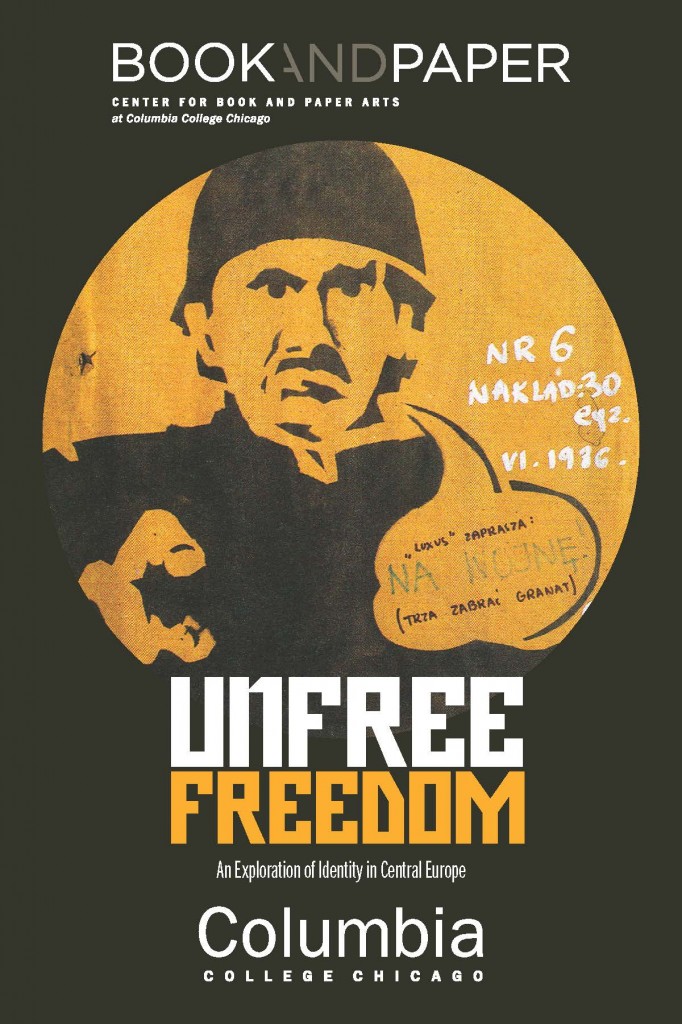
Within the 1104 S Wabash building is the Center for Book and Paper Arts. After coming across a blurb about the spotlighted fall exhibition “UNFREE FREEDOM:  An Exploration of Identity in Central Europe” I decided to go check out this ‘Center for Book and Paper Arts’ that I had never known existed. This sort of realization happens often here, especially to majors outside of the artistic fields. The politically charged collection of print work at UNFREE FREEDOM attracted me with its once illegal subject material and kept me interested with its emotional and historical insight. The artwork displayed was not made by Columbia students, rather curated by one; nevertheless it was still housed within a campus building. Inversely to this, it would be hard to find a venue in Chicago outside of the South Loop that had not at one time housed some Columbia copyrighted art. The art scene at Columbia is the arts scene of Chicago.
I mentioned before I’m a hipster, and hipster is as hipster does. And this hipster goes to a lot of shows.  From Schuba’s on the North Side to Lucky Gator on the West Side to Linda’s Lounge on the South Side ice breaking with talented artists is made easy thanks to a shared Columbian schooling experience.
It’s quite apparent that regardless of the feelings had about Columbia in Chicago, the direct relationship is undeniable. We house art that is not ours and purport onto others art that is. At some point in my time spent at Columbia I came to the realization that I wasn’t just getting an education from Columbia, I was getting an education from Chicago. Though the street-smart attitude Columbia provides sometimes comes back to bite it in its ass.
The Good, The Bad, The Ugly:
The student body at Columbia is drastically liberally minded, as are much of its faculty. When I left St. John’s running for my life after being immersed in a conservative setting Columbia’s liberal consciousness was a definite attractive quality. I’m not a huge fan of Chicago; I find the racial segregation unsettling. I am not a huge fan of the Midwest; I often find the attitude offensive. But I love Columbia for not bearing the attributes I find problematic of its geographic context. Columbia has a very ‘open door’ policy, if you have a means of funding the $20,094 tuition (without additional attendance fees).
Columbia, sadly, also has the tendency to be extremely disappointing. If you have ever taken a gen-ed course then you understand what I mean by that. I, as many other students, could write a list of all the classes I’ve taken which were a complete waste of time and money… a lot of money.  The amazing instructors at Columbia and its widely accepting principle sometimes work to highlight those specific moments when faculty isn’t amazing and when Columbia isn’t abiding by this valuable trait.  
It’s no wonder that an Occupy Columbia group formed in solidarity with the growing nationwide movement. Columbia students have the habit of having a lot of things to express. Where Columbia has disappointed, is by continually denying the approval of a charter in order to validate the collective as a student organization, though it has done so for people who shared a common interest in a certain brand of shoes.  Of course it gets much more ugly when you consider the current prioritization and the heated disputes surrounding it, but you can go to an Occupy Columbia, Coalition Against the Corporatization of High Education or PFac meeting to learn more about that.
Back on the scene:
Although Columbia has some definite weaknesses within it’s muddied administration and general education curriculum, it is a place that produces people willing enough to question those very structures.  Having experienced vastly different forms of higher education, including some abroad, I think I feel comfortable in stating and justifying that whatever the vague scene may be here at Columbia. I like it. There’s a versatility at this school that to prescribe a certain identity, well I’d I have to talk to the Professor with the tattoos and gauges to clear up what that would entail, nevertheless, it would definitely be a problematic process.


Tuesday, November 22, 2011

Dave Chapelle's Block Party

On September 18th 2004 Dave Chappelle threw a block party in Brooklyn, NY. Indie film favorite, Michel Gondry, filmed the event and in 2005 Dave Chappelle’s Block Party was released in theaters.
“5,000 black people chilling in the rain, 19 white people peppered into the crowd, trying to find a Mex-i-can,” comedic icon Chappelle faux-spoken-word-like recites to his Clinton Hill audience. Amidst his generous offering of hip-hop legendaries, passionate dissidents and creative polymaths, a common bond was shared, the spirit of the ever-dissipating black revolutionary. Inspired by documentation of the 1972 Wattstax music festival, “the Afro-American answer to Woodstock,” Dave Chappelle stood in the footsteps (and surely not for the first time) of Richard Pryor and gave us a film many of his audience was not expecting, that all of his fans were. 
On the seven-year anniversary of the LA Watts riots, Stax Records put the resources forth to fund the mega congregation of African American cultural enthusiasts, the Wattstax Music Festival. Now that I’ve provided enough information to get through the first five minutes of a Black Arts Movement class, I want to highlight the similarities between these two events, and why it’s so important.  The similarities part is easy, just watch the two trailers.

Both films even had a white director (gasp!)

Dave Chappelle in many regards is a black revolutionary. The logo of his infamous Chappelle Show boasts the distinct colors of Black solidarity. Every episode of the show fades in and out with the immediately recognizable instrumental of the most militant Black Power musicians Gondry will ever film... Dead Prez. Although obviously holding a special place in Dave’s heart, Dead Prez were not the only revolutionaries performing at the block party. Also present: the show stopping Fugees, BlackStar, (named after Marcus Garvey’s Pan-African sea voyage line), The Roots Crew, Common, pre-super nova Kanye West, and Jill Scott -- all aware, proud and very vocal of their black identities.  Dave Chappelle’s Block Party was one Jesse Jackson Black Litany away from Wattstax, until Fred Hampton Jr. took the stage riling the crowd up to chant “hands up, fists clenched, eyes open!” … sounding pretty dashiki-era Jesse Jackson to me.
The question many people found themselves asking after seeing Block Party, is why Chappelle went from ‘I’m Rick James, bitch!’ to ‘I am somebody!’, maybe the better question is, why he went to 'I'm Rick James' in the first place. 2004/5 were rough years for Mr. Chappelle; we all know it, because we all saw it.  It seemed to be with the same amount of force that his own talents as an entertainer catapulted his show to a mega hit that the story of Chappelle’s crack addicted mental breakdown ( which caused him to walk away from a $55 million contract ) spread like wildfire.  These rumors, as the celebrity ones often are, were based on lies created by burned executives, as well as the reaction to, as a professor of mine once said, “the one thing a black celebrity can not do, quit.”
As Chappelle mentions in an Inside the Actors Studio interview, this pressure is not something new to celebrities, black celebrities in particular. Fellow members on the Block Party setlist  also have experienced the media buzz of a mental breakdown. Upon deciding to deviate from the dictations of their ‘suits’ Erykah Badu, Lauryn Hill and every other week, Kanye West fall victim to media spin (though I think in this post-supernova Kanye world, his ‘breakdowns’ have become another one of his selling points). Ms. Hill addressed such rumors in a recent interview with NPR

"Oftentimes," Hill says, "the machine can overlook the need to take care of the people who produce the sounds that have a lot to do with the health and well-being of society...And it's important that people be given the time that they need to go through, to grow, so that the consciousness level of the general public is properly affected."

     Although things aren't exactly peachy for black celebrities in todays world, things are surely not as bad as they were in 1965 . Despite this difference,  Dave Chappelle‘s Block Party, much like Wattstax, successfully provided a necessary outlet for these conscious-minded black celebrities to re-establish the firm bond they hold within the multitude of communities that produced them.  Many people were shocked at the return of The Fugees, in reality The Fugees only left the mainstream eye, they never left Bedstuy. “Old people fucking love me!” Chappelle boasts in the film --Dave, everyone loves you. Fans of Chapelle, of Badu, of Ms. Hill, when faced with tarnishing rumors commonly disregard them, nevertheless it’s an exhausting process watching your idols neglect to receive the amount of respect their talents deserve. It’s refreshing when they do. 

Dave Chappelle’s Block Party is an inspiring documentary following the hilarious and charming David Chappelle on a mission to offer one of greatest congregations of African American culture back to the hands of the African American community. 

If you're cringing in your seat that you didn't get to attend Chappelle's Block Party, check out the Afro-Punk Festival. A free event held annually in Brooklyn that boasts previous performances by Janelle Monae, Cee Lo Green, Bad Brains, Mos Def, Saul Williams and hundreds others. Just a hunch, but i'm fairly certain Lupe will be included on the set list for this year. 

Tuesday, November 8, 2011

I'd Rather Not Be Reviewing Mad Men

I’ve always been a conscientious objector to the hit AMC television show Mad Men. Sadly the programs long lasting and deeply rooted cultural phenomena has shown no signs of tapering since its 2007 premier, making it require more effort to avoid succumbing to the new TV icon than to continue to ‘hate for hatings sake’. I truly attempted to put aside my hypocritical feminism to try and get why Mad Men is different than the endless other representations of an idyllic patriarchic world, as well as what it offers people that they are so willing to take.
The thing about Mad Men is that the ‘people’ I’m referring too aren’t so far away from myself. A lot of my friends love Mad Men; a lot of friends whose taste I respect love Mad Men. Sometimes upsettingly a lot of my friends are males and males are above and beyond the dominant constituency voting the show into presidency. I objected to Mad Man because I didn’t want to see misogyny done in a cool way, so thanks to the magic of Netflix, I spent the past week watching the first season.
 Alas, there is no doubt about it. It’s a cool show. Although characters such as Peggy place the blame on women who did not seamlessly move up in the corporate world as she does, which is utter bullshit, Mad Men is a good television show. Striking the perfect sprinkling of seasoned television vets and fresh faces, the cast (outside of John Hamms lackluster Don Draper impression, though I hear he learns how to move his face in the following seasons) blends with a charming chemistry to set this 1960 ad agency drama.  The soundtrack frames the show in edge, borrowing some artistic street cred from Bob Dylan and contemporary indie alike. The cinematographers are surely paid well because aesthetically the show is beautiful.  Aside from all the technical film jargon I could say without really knowing if it made sense, the retro dresses and constant cigarette smoking is just nice to look at (said the hypocritical feminist). No matter how much I realized my worst fears in enjoying a uniqueness of quality in the production, I have little doubt I will not continue to have an unnecessarily long debate with someone when I find out they are a member of the Mad Men cult.
Yes, I get that life in the 1960’s was sexist. Yes, I do understand this is a depiction of such social relations. But what I find most problematic as mentioned before is what this show offers. I find it almost embarrassing to admit that I feel as if there is some hidden desire in men to be Don Draper, to live in the 1960’s world of endless pretty dresses and endless Lucky Strikes.  I can watch American History X, appreciate it for what it expresses, without wanting to be Edward Norton. I watch Mad Men, appreciate it for what it expresses, but I want to be Don Draper. That to me is irresponsible and dangerous.  So I will remain a conscientious objector to the show, as I finish watching the next three seasons with lingering thoughts of why so many male advertising majors reference the program when prompted as to how they came to their field of study.  

Judge for yourself, the first four seasons of Emmy award winning Mad Men are available for instant play on Netflix. Re-runs play daily on AMC, with season five returning in 2012. 

Monday, October 31, 2011

UNFREE FREEDOM at the Center for Book and Paper Arts

Columbia has a Center for Book and Paper Arts; it is a pretty cool place that holds some pretty cool stuff.  After coming across a blurb about the currently spotlighted fall exhibition UNFREE FREEDOM:  An Exploration of Identity in Central Europe (curated by Janiel Engelstand) I decided to go check out this ‘Center for Book and Paper Arts’ that I had never known existed. Saturday afternoon a reception was held for the exhibit at the CBPA’s residence on the second floor of the 1104 S. Wabash building.  Although there will not be free wine in tiny plastic cups when you go, I suggest very much for anyone interested in expressions of identity, minority, oppression, politics or just in the evolution of personal style, to attend UNFREE FREEDOM, which is running through December 10th in one of Columbia’s hidden-gem spaces.
The exhibition itself is very straightforward as the intentions of the six artists are fairly easy to read. Perhaps this was due to the well know historical and social context in the post-communist region of what once was the Eastern-bloc, or perhaps it is because you can quite literally read about the art and in most cases the art itself. 
 Nothing makes me want to engage with art more, than to know it was once considered illegal to make.  The photo collage Exclamation Mark  (1974) by Slovak artists Rudolf Sikora attributes one of the many relations the artists presented here have with their Central European identity.  His work is blatantly political and driven by a reactionary mentality. It’s urgency and self-importance displays this, as its symbol and detail offer its informative message. Sikora was not allowed to display his art to the knowledge of the communist regime in what was 1974 Czechoslovakia, as opposed to the 'unfree, freedom' others had to created art that the fascist regime approved of.
Also included in the exhibit are the works of youthful contemporaries who actively engage within this post-communist region, without knowledge of what ‘communism’ was actually like. Their relationship with their regional identity clearly differs from that of a political Sikora or a Cerny, nevertheless the productions are boundlessly intriguing.
 A series of hand-drawn super simplistic depictions of artist Magda Stanova’s travels around her neighboring nations exemplifies this negotiated contemporary voice in the discourse. Within her hand-made book titled Travel Guide, the 1981 born artist captures what images, such as the landscapes of identical architecture and the train ride from Bratislava to Munich, mean to someone who has interacted with it as it is today (or in 2008 when she compiled her work), in the context of what it was yesterday. With an innocent and unbiased eye, subjected only to her apparent attraction to the idiosyncrasies of place, Stanova offers an interpretation of how how we interact with that which surrounds us. On the final page of the book she states "These places were in this state once upon a time. Maybe they are still like this, but they might change."
            UNFREE FREEDOM:  An Exploration of Identity in Central Europe is a facet to the larger collaboration titled Voices From the Center: Central Europeans Reflect on Life Before and After the Fall of the Berlin Wall . Although the varying methods of practice these artists have used to find a grasp at what it means to be where they are from, there is something synonymous in every work. They all have a lot of questions, and this manifestation of self-acknowledgement, of self-identity through their art seems to be their answer.
            UNFREE FREEDOM:  An Exploration of Identity in Central Europe, a short but sweet encapsulation of the movement in claiming and maintaining identity is displayed in the Center for Book and Paper Arts, a beautiful space designated for multimedia exhibits making use of the artistic manipulations of text. Located on the 2nd floor of the 1104 S. Wabash building UNFREE FREEDOM will be running through December 10th

Monday, October 24, 2011

An Interpretation of My Interpretation of My Art.

I, unlike many of my peers, am not a big fan of taking pictures. This is proven to me every time I log onto Facebook as my network of friends rapidly upload photos from their trip to Mexico, or their cousins wedding, or that thing they ate for lunch, or that party where everyone got drunk enough to enjoy dub-step. Instead I have always found myself inclined to memorialize important events more-so with physical objects rather than photographic documentation. This has resulted in two things, me continually questioning if I will ever end up on an episode of Hoarders and my collage from my trip to Europe this past summer. This homage to my recent travels is my version of a photo album that will never be seen on Facebook, and is the subject of my assessment on an object from my own personal museum.
I will probably never be able to thank the neighbor who decided to place their no longer used frame by the recycling bin on our floor, but I wish I could, for if it had not been for that, my ‘work of art’ would be more of a pile of European garbage on my bookshelf. Over three months travelling I kept the many things I made use of. My transit passes, my phone cards, my ticket stubs, and empty boxes of Marlboro Reds all blazoned with surgeon generals warnings, many in languages I am no longer able to differentiate from each other (I know Hungarian sounds prettier than Czech, but it all reads like Greek to me).  The preceding is just to name a few as the frame is riddled with countless representations of specific moments all culminating to answer to the question, “So, what did you do this summer?”
Much as Berger highlights in his BBC series Ways of Seeing, the way anyone and everyone views my collage is subjected to their own relationship with the piece, which in many ways will differ from my own intention of creating it. One person took notice of remnants from a program about the performance of Much Ado About Nothing at the Globe Theater. We shared a laughing bond over the inclusion of an actor made famous by The Fresh Prince of Bel-Air in the cast description. Just as similarly someone took notice of the cardboard cut out of half a red car, equipped with black string for neck adornment. Although I got the half cardboard red car necklace at a music festival in Slovakia, where I hung out with my favorite bands on a tarmac all day and my favorite Central Eastern Europeans at their mountain pool house all night, the person viewing this detail would fail to see, or feel, any of that. I have a personal relationship with this ‘work of art’, it acts as a reminder of the ways I threw myself into situations I never want to forget.
The ways in which people interact with my collage will differ depending on their affiliations with the details, the whole, and the context in which it is seen. My mother will see it as an upsetting realization that I still smoke cigarettes. My friends will see it as an outlet if they feel like hearing a story of a ridiculous situation I found myself in.  My acquaintances will see it as another typical manifestation of personal scraps in a frame.  Nevertheless it speaks to my tendency to form bonds with people I’ve never met, places I’ve never gone, languages I’d never spoke, and all the objects that I used in the process of making these things no longer true. It speaks to my ways of feeling art in relation to myself rather than seeing it for its aesthetic value. Regardless people mostly just notice that there are only 19 cigarettes in a box of Marlboros in Turkey instead of 20.  

Tuesday, October 18, 2011

A Review in the Form of a Barthes Mythology

     If you have ever been to a library, lived with someone who was an avid listener of NPR or have ever attended a liberal arts college, you have most likely encountered the handcrafted ceramic coffee mug. Aside from suggesting an easy gift idea, this staple attribute to the desk of any liberal-minded, early morning riser suggests a representation of a much larger social context. Despite not having a more catchy or memorable nomenclature, the hand/home-made, ceramic/pottery, tea/coffee mug is an object so commonly exchanged in our culture that the lack of such a known denomination is as good of a place as any to begin a ‘mythology’ of such an object.

     After the turn of the industrial revolution in the late 19th century many wrote on the large decline in what was referred to as ‘organic culture’. Since then, although the prevalence of the industrial society in the Western world has diminished (rest in peace American factories), the hierarchal status that ‘unique artisan’ productions have over the mass-produced has remained. What reflects this unique artistry more than the fact these mugs are so unique that the artist themselves each have their own name to refer to them as?
      This mentality is projected everywhere. It’s better to own the limited released vinyl from your favorite band than to download the mp3 from iTunes. It’s better to see that documentary the Music Box opened last week which has been sitting in a Swedish basement for thirty years than to go see the remake of Footloose (again something deemed higher in culture with an elusive name). It is this sort of discretion that we often gauge to determine someone who is cultured, to someone that is not. A contrived judgment surely, yet who exactly are the people to be judged for such judgments? The 1999 film Fight Club broached this subject cogently with its ‘Ikea scene’ depicted here....

     It does not matter who exactly made these objects, what the colors mean, wether or not it is aesthetic appearance looks.... sort of like poop, all that matters is that it makes a claim about who you are. People like to relate themselves to people, there is nothing foreign about this concept. This desire of relation includes being a member of the handmade ceramic coffee mug club; I even hope to be apart of it one day. We are undeniably a communal species; the issue is that our communal nature has been modified for commodification. Early-rising, liberal-minded persons are not usually outright supporters of artisan exploitation for the purpose of capitalistic functions, but much like the ceramic mugs, early-rising liberal-minded persons are subject to capitalistic commodification just as readily. The 'myth' is that we are not, the 'myth' is that these ceramic mugs are not, the 'myth' is that buy representing ourselves, we are expressing who we are.

Monday, October 10, 2011

Something Out Loud: Review of LaGravenese's 'Living Out Loud'

Richard LaGravenese attempted to make his directorial debut by making a mark in the feel-good, dramatic comedy world with his 1998 production Living Out Loud.  Although stacked with the Hollywood hitters Holly Hunt, Danny DeVito and Queen Latifah, LaGravenese failed to stack his film with character development, relatable plots, and a strong overall theme in general. Who would ever expect that this concoction would turn out a much more lack luster and confusing film than the promise of a feel-good rom-com usually delivers on?


The film starts off equip with all the tools of building a relationship with the audience. An Upper East Side woman Judith (Holly Hunt) is recently divorced of a cheating ex and finds herself riddled with the guilt of powerlessness she has to fix the world of all its problems. Struggling to find a solution to her own overwhelming loneliness she acquires a soulful best friend Liz (Queen Latifah) and back up plan man Pat (Danny DeVito) who help her realize the possibilities she has to relieve the powerlessness over herself. Judith grows to understand her own capabilities, to get over her ex and get on with herself.  However this is, regrettably, an extreme oversimplification of the muddied plot that drives this film.
After Judith encounters a mysterious rendezvous in a closet with a nameless romantic, the reoccurring theme of social responsibility is suddenly dropped, never making a return appearance. Is this meant to speak on the selfish ways in which when we finally have something to distract our hearts with we no longer carry the tendency to care about those outside of ourselves? The soulful best friend finds herself in relationships with gay men.  Maybe a statement made on the impossibility for even the most stable and self-aware of us all to find true happiness in love? Finally there’s the co-dependent back up guy, who Judith perpetually uses as someone to turn to when feeling down. After standing resiliently by her side in support, Pat is eventually turned down when Liz, thanks to his help, feels ready enough to be on her own. Lucky for him he ends up finding a new object of affection to smother in love by the resolution of the film.  Maybe telling us we are shit out of luck unless we are willing to completely base ourselves around others, never giving up no matter the amount of times rejected? Perhaps a dramatic-comedy based around DeVito’s character would make a better film in this genre.
I can excuse the random 90’s quasi-lesbian themed dance sequence mid movie, or the loose end string or two in this film, if it delivered on its main point. And this is why Living Out Loud and LaGravenese lost me … why did he make this movie and what is his trying to prove through it? I appreciate his attempts of revamping the new-divorce-trying-to–find-beauty-in–life-again story with more intricate plots, however, they all seem to simmer down to cheap thickeners that evaporate in minutes. After so many questions, and not nearly as many answers Living Out Loud would be my pick for feel-confused movie of 1998.