Monday, October 31, 2011

UNFREE FREEDOM at the Center for Book and Paper Arts

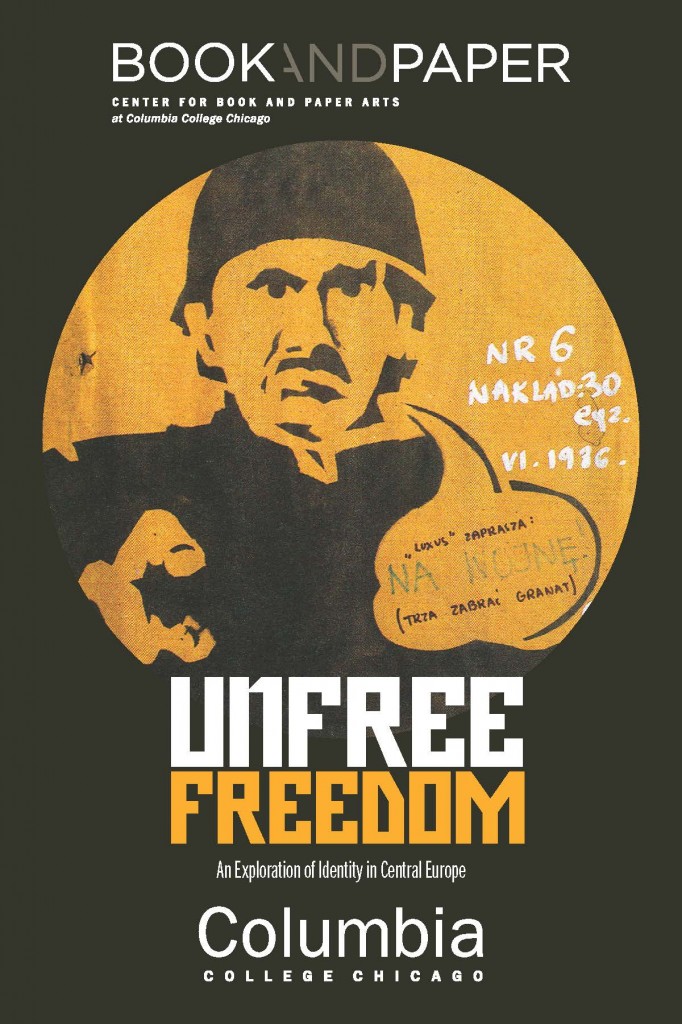
Columbia has a Center for Book and Paper Arts; it is a pretty cool place that holds some pretty cool stuff.  After coming across a blurb about the currently spotlighted fall exhibition UNFREE FREEDOM:  An Exploration of Identity in Central Europe (curated by Janiel Engelstand) I decided to go check out this ‘Center for Book and Paper Arts’ that I had never known existed. Saturday afternoon a reception was held for the exhibit at the CBPA’s residence on the second floor of the 1104 S. Wabash building.  Although there will not be free wine in tiny plastic cups when you go, I suggest very much for anyone interested in expressions of identity, minority, oppression, politics or just in the evolution of personal style, to attend UNFREE FREEDOM, which is running through December 10th in one of Columbia’s hidden-gem spaces.
The exhibition itself is very straightforward as the intentions of the six artists are fairly easy to read. Perhaps this was due to the well know historical and social context in the post-communist region of what once was the Eastern-bloc, or perhaps it is because you can quite literally read about the art and in most cases the art itself. 
 Nothing makes me want to engage with art more, than to know it was once considered illegal to make.  The photo collage Exclamation Mark  (1974) by Slovak artists Rudolf Sikora attributes one of the many relations the artists presented here have with their Central European identity.  His work is blatantly political and driven by a reactionary mentality. It’s urgency and self-importance displays this, as its symbol and detail offer its informative message. Sikora was not allowed to display his art to the knowledge of the communist regime in what was 1974 Czechoslovakia, as opposed to the 'unfree, freedom' others had to created art that the fascist regime approved of.
Also included in the exhibit are the works of youthful contemporaries who actively engage within this post-communist region, without knowledge of what ‘communism’ was actually like. Their relationship with their regional identity clearly differs from that of a political Sikora or a Cerny, nevertheless the productions are boundlessly intriguing.
 A series of hand-drawn super simplistic depictions of artist Magda Stanova’s travels around her neighboring nations exemplifies this negotiated contemporary voice in the discourse. Within her hand-made book titled Travel Guide, the 1981 born artist captures what images, such as the landscapes of identical architecture and the train ride from Bratislava to Munich, mean to someone who has interacted with it as it is today (or in 2008 when she compiled her work), in the context of what it was yesterday. With an innocent and unbiased eye, subjected only to her apparent attraction to the idiosyncrasies of place, Stanova offers an interpretation of how how we interact with that which surrounds us. On the final page of the book she states "These places were in this state once upon a time. Maybe they are still like this, but they might change."
            UNFREE FREEDOM:  An Exploration of Identity in Central Europe is a facet to the larger collaboration titled Voices From the Center: Central Europeans Reflect on Life Before and After the Fall of the Berlin Wall . Although the varying methods of practice these artists have used to find a grasp at what it means to be where they are from, there is something synonymous in every work. They all have a lot of questions, and this manifestation of self-acknowledgement, of self-identity through their art seems to be their answer.
            UNFREE FREEDOM:  An Exploration of Identity in Central Europe, a short but sweet encapsulation of the movement in claiming and maintaining identity is displayed in the Center for Book and Paper Arts, a beautiful space designated for multimedia exhibits making use of the artistic manipulations of text. Located on the 2nd floor of the 1104 S. Wabash building UNFREE FREEDOM will be running through December 10th

Monday, October 24, 2011

An Interpretation of My Interpretation of My Art.

I, unlike many of my peers, am not a big fan of taking pictures. This is proven to me every time I log onto Facebook as my network of friends rapidly upload photos from their trip to Mexico, or their cousins wedding, or that thing they ate for lunch, or that party where everyone got drunk enough to enjoy dub-step. Instead I have always found myself inclined to memorialize important events more-so with physical objects rather than photographic documentation. This has resulted in two things, me continually questioning if I will ever end up on an episode of Hoarders and my collage from my trip to Europe this past summer. This homage to my recent travels is my version of a photo album that will never be seen on Facebook, and is the subject of my assessment on an object from my own personal museum.
I will probably never be able to thank the neighbor who decided to place their no longer used frame by the recycling bin on our floor, but I wish I could, for if it had not been for that, my ‘work of art’ would be more of a pile of European garbage on my bookshelf. Over three months travelling I kept the many things I made use of. My transit passes, my phone cards, my ticket stubs, and empty boxes of Marlboro Reds all blazoned with surgeon generals warnings, many in languages I am no longer able to differentiate from each other (I know Hungarian sounds prettier than Czech, but it all reads like Greek to me).  The preceding is just to name a few as the frame is riddled with countless representations of specific moments all culminating to answer to the question, “So, what did you do this summer?”
Much as Berger highlights in his BBC series Ways of Seeing, the way anyone and everyone views my collage is subjected to their own relationship with the piece, which in many ways will differ from my own intention of creating it. One person took notice of remnants from a program about the performance of Much Ado About Nothing at the Globe Theater. We shared a laughing bond over the inclusion of an actor made famous by The Fresh Prince of Bel-Air in the cast description. Just as similarly someone took notice of the cardboard cut out of half a red car, equipped with black string for neck adornment. Although I got the half cardboard red car necklace at a music festival in Slovakia, where I hung out with my favorite bands on a tarmac all day and my favorite Central Eastern Europeans at their mountain pool house all night, the person viewing this detail would fail to see, or feel, any of that. I have a personal relationship with this ‘work of art’, it acts as a reminder of the ways I threw myself into situations I never want to forget.
The ways in which people interact with my collage will differ depending on their affiliations with the details, the whole, and the context in which it is seen. My mother will see it as an upsetting realization that I still smoke cigarettes. My friends will see it as an outlet if they feel like hearing a story of a ridiculous situation I found myself in.  My acquaintances will see it as another typical manifestation of personal scraps in a frame.  Nevertheless it speaks to my tendency to form bonds with people I’ve never met, places I’ve never gone, languages I’d never spoke, and all the objects that I used in the process of making these things no longer true. It speaks to my ways of feeling art in relation to myself rather than seeing it for its aesthetic value. Regardless people mostly just notice that there are only 19 cigarettes in a box of Marlboros in Turkey instead of 20.  

Tuesday, October 18, 2011

A Review in the Form of a Barthes Mythology

     If you have ever been to a library, lived with someone who was an avid listener of NPR or have ever attended a liberal arts college, you have most likely encountered the handcrafted ceramic coffee mug. Aside from suggesting an easy gift idea, this staple attribute to the desk of any liberal-minded, early morning riser suggests a representation of a much larger social context. Despite not having a more catchy or memorable nomenclature, the hand/home-made, ceramic/pottery, tea/coffee mug is an object so commonly exchanged in our culture that the lack of such a known denomination is as good of a place as any to begin a ‘mythology’ of such an object.

     After the turn of the industrial revolution in the late 19th century many wrote on the large decline in what was referred to as ‘organic culture’. Since then, although the prevalence of the industrial society in the Western world has diminished (rest in peace American factories), the hierarchal status that ‘unique artisan’ productions have over the mass-produced has remained. What reflects this unique artistry more than the fact these mugs are so unique that the artist themselves each have their own name to refer to them as?
      This mentality is projected everywhere. It’s better to own the limited released vinyl from your favorite band than to download the mp3 from iTunes. It’s better to see that documentary the Music Box opened last week which has been sitting in a Swedish basement for thirty years than to go see the remake of Footloose (again something deemed higher in culture with an elusive name). It is this sort of discretion that we often gauge to determine someone who is cultured, to someone that is not. A contrived judgment surely, yet who exactly are the people to be judged for such judgments? The 1999 film Fight Club broached this subject cogently with its ‘Ikea scene’ depicted here....

     It does not matter who exactly made these objects, what the colors mean, wether or not it is aesthetic appearance looks.... sort of like poop, all that matters is that it makes a claim about who you are. People like to relate themselves to people, there is nothing foreign about this concept. This desire of relation includes being a member of the handmade ceramic coffee mug club; I even hope to be apart of it one day. We are undeniably a communal species; the issue is that our communal nature has been modified for commodification. Early-rising, liberal-minded persons are not usually outright supporters of artisan exploitation for the purpose of capitalistic functions, but much like the ceramic mugs, early-rising liberal-minded persons are subject to capitalistic commodification just as readily. The 'myth' is that we are not, the 'myth' is that these ceramic mugs are not, the 'myth' is that buy representing ourselves, we are expressing who we are.

Monday, October 10, 2011

Something Out Loud: Review of LaGravenese's 'Living Out Loud'

Richard LaGravenese attempted to make his directorial debut by making a mark in the feel-good, dramatic comedy world with his 1998 production Living Out Loud.  Although stacked with the Hollywood hitters Holly Hunt, Danny DeVito and Queen Latifah, LaGravenese failed to stack his film with character development, relatable plots, and a strong overall theme in general. Who would ever expect that this concoction would turn out a much more lack luster and confusing film than the promise of a feel-good rom-com usually delivers on?


The film starts off equip with all the tools of building a relationship with the audience. An Upper East Side woman Judith (Holly Hunt) is recently divorced of a cheating ex and finds herself riddled with the guilt of powerlessness she has to fix the world of all its problems. Struggling to find a solution to her own overwhelming loneliness she acquires a soulful best friend Liz (Queen Latifah) and back up plan man Pat (Danny DeVito) who help her realize the possibilities she has to relieve the powerlessness over herself. Judith grows to understand her own capabilities, to get over her ex and get on with herself.  However this is, regrettably, an extreme oversimplification of the muddied plot that drives this film.
After Judith encounters a mysterious rendezvous in a closet with a nameless romantic, the reoccurring theme of social responsibility is suddenly dropped, never making a return appearance. Is this meant to speak on the selfish ways in which when we finally have something to distract our hearts with we no longer carry the tendency to care about those outside of ourselves? The soulful best friend finds herself in relationships with gay men.  Maybe a statement made on the impossibility for even the most stable and self-aware of us all to find true happiness in love? Finally there’s the co-dependent back up guy, who Judith perpetually uses as someone to turn to when feeling down. After standing resiliently by her side in support, Pat is eventually turned down when Liz, thanks to his help, feels ready enough to be on her own. Lucky for him he ends up finding a new object of affection to smother in love by the resolution of the film.  Maybe telling us we are shit out of luck unless we are willing to completely base ourselves around others, never giving up no matter the amount of times rejected? Perhaps a dramatic-comedy based around DeVito’s character would make a better film in this genre.
I can excuse the random 90’s quasi-lesbian themed dance sequence mid movie, or the loose end string or two in this film, if it delivered on its main point. And this is why Living Out Loud and LaGravenese lost me … why did he make this movie and what is his trying to prove through it? I appreciate his attempts of revamping the new-divorce-trying-to–find-beauty-in–life-again story with more intricate plots, however, they all seem to simmer down to cheap thickeners that evaporate in minutes. After so many questions, and not nearly as many answers Living Out Loud would be my pick for feel-confused movie of 1998. 

Monday, October 3, 2011

Saturday Night at Schubas

Astronautalis was by far the best thing about Columbia’s student run AEMMP record label day party at SXSW six months ago (and that’s including the free Sierra Nevada IPA and vegan tacos). So when conducting my weekend routine of show searching, seeing his name top billing Saturday night at Schubas caused me to squeal in excitement over the promise of another great performance. Similarly to Astronautalis only thinking “…eighty people, and that’s like tops’’ would show up for the 10 pm show “...and I’m the optimist of the band”, by the end of the night, we both realized we had set our expectations far too low. I wouldn’t call Schubas one of my favorite venues in the city (with their twelve dollar covers fees and six dollar beers) but hitting up the ATM, the red line, and the fifteen-minute walk from the Belmont stop was something well worth it.

    I showed up at the event with just enough time to catch the first acts final few … songs? Sharkula (aka thigahmahjigee) a former Columbia student, probably former sane person, and Chicago lengend as always fit his m.o., leaving the audience wondering: Is he an emcee or a comedian? Is he on more drugs than anyone i've ever met or the funniest person i've ever met? Is he serious? To which after his performance and a proposal to get married and have his kids (his second of the night) his answer to all those questions is “Maybe”.  No matter the sensibility that goes behind what Sharkula is, it’s always funny, in the best ‘wtf’ kind of way. Check out a clip from his  docu (or mocu??) -mentary 'Diarrhea of a Mad Man', and yes his performances are just like it, but  with an added couple of beers.
       After Sharkula, set up another local act ANT’LRD, an absolutely impossible presence to find on YouTube. Twenty minutes into MacBookPro ambient, drone, noise, deconstructed bass beats and of the crowd lining up at the bar to get drinks during this ‘intermission’ ANT’LRD finally showed the crowd some passion and began to wail on his drum kit at a seminal breakdown of the set. ANT’LRD is not a boring act; just all about the suspense, however after the ADHD party of Sharkula the crowd wasn’t very receptive of such meanderings. “I made this for people to get high to,” states ANT’LRD, so if you’re into the kind of music that is good to get high to, check out his new album Pop’s Lair by Step Peeper Records.
     What the crowd was in the mood for was Astronautalis, a performer who commands the stage and pulls you into his songs, but not without effort. There’s always been something so charming about an artist who sweats bullets to the point of drenching his blushed red skin riddled with veins that look ready to burst. Astronautalis is an indie rock-ish, spoken word poet-like, hip-hop act with (sometimes) a live band and (always) a free-style or two for the crowd he appreciates so much --he told us so in his freestyle about how he only expected eighty people tops to come to the show.     
     Although his music style doesn’t appeal to everyone, (personally that Rhymesayer’s breed of indie hip-hop was never something I’d trek to Minneapolis for) Anstronautalis is definitely a stand-out performer deserving of a good review … or thirty. He is currently on tour, not expected to be back in the Chicago area for months, but keep your eyes out for this oh so charming man. And check out Schubas if you’re looking for a nightly friendly crowd, who all most likely have decently paying jobs.