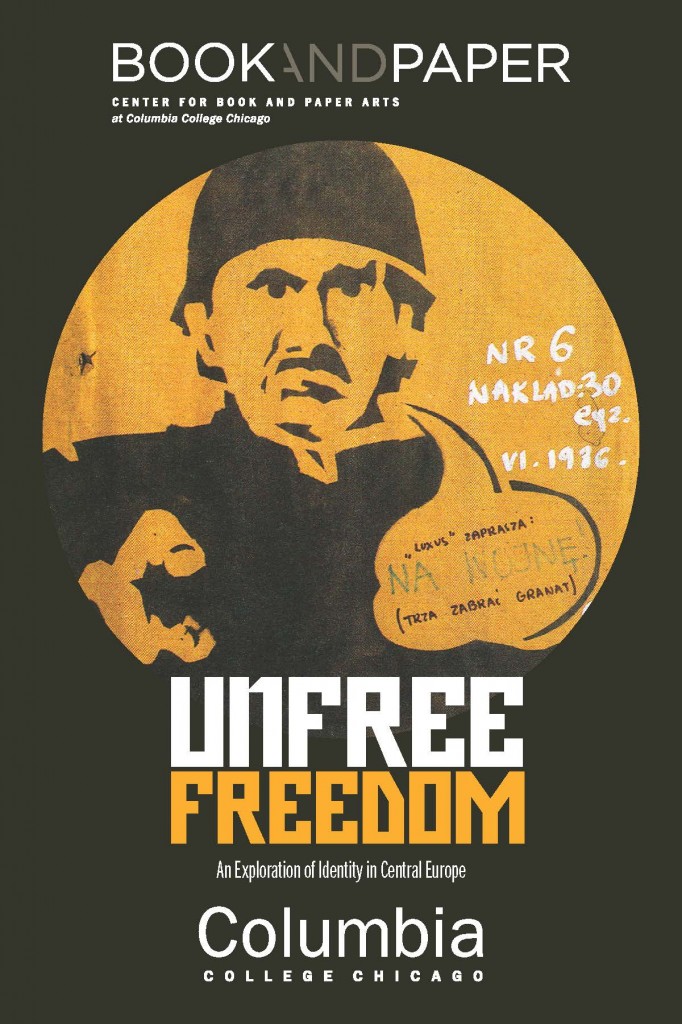
 Columbia has a Center for Book and Paper Arts; it is a pretty cool place that holds some pretty cool stuff. After coming across a blurb about the currently spotlighted fall exhibition UNFREE FREEDOM: An Exploration of Identity in Central Europe (curated by Janiel Engelstand) I decided to go check out this ‘Center for Book and Paper Arts’ that I had never known existed. Saturday afternoon a reception was held for the exhibit at the CBPA’s residence on the second floor of the 1104 S. Wabash building. Although there will not be free wine in tiny plastic cups when you go, I suggest very much for anyone interested in expressions of identity, minority, oppression, politics or just in the evolution of personal style, to attend UNFREE FREEDOM, which is running through December 10th in one of Columbia’s hidden-gem spaces.
 The exhibition itself is very straightforward as the intentions of the six artists are fairly easy to read. Perhaps this was due to the well know historical and social context in the post-communist region of what once was the Eastern-bloc, or perhaps it is because you can quite literally read about the art and in most cases the art itself.
 Also included in the exhibit are the works of youthful contemporaries who actively engage within this post-communist region, without knowledge of what ‘communism’ was actually like. Their relationship with their regional identity clearly differs from that of a political Sikora or a Cerny, nevertheless the productions are boundlessly intriguing.
 A series of hand-drawn super simplistic depictions of artist Magda Stanova’s travels around her neighboring nations exemplifies this negotiated contemporary voice in the discourse. Within her hand-made book titled Travel Guide, the 1981 born artist captures what images, such as the landscapes of identical architecture and the train ride from Bratislava to Munich, mean to someone who has interacted with it as it is today (or in 2008 when she compiled her work), in the context of what it was yesterday. With an innocent and unbiased eye, subjected only to her apparent attraction to the idiosyncrasies of place, Stanova offers an interpretation of how how we interact with that which surrounds us. On the final page of the book she states "These places were in this state once upon a time. Maybe they are still like this, but they might change."
UNFREE FREEDOM: An Exploration of Identity in Central Europe is a facet to the larger collaboration titled Voices From the Center: Central Europeans Reflect on Life Before and After the Fall of the Berlin Wall . Although the varying methods of practice these artists have used to find a grasp at what it means to be where they are from, there is something synonymous in every work. They all have a lot of questions, and this manifestation of self-acknowledgement, of self-identity through their art seems to be their answer.
UNFREE FREEDOM: An Exploration of Identity in Central Europe, a short but sweet encapsulation of the movement in claiming and maintaining identity is displayed in the Center for Book and Paper Arts, a beautiful space designated for multimedia exhibits making use of the artistic manipulations of text. Located on the 2nd floor of the 1104 S. Wabash building UNFREE FREEDOM will be running through December 10th.

Stacy, this is a solid review, although I feel like it takes a little while to get fully up to speed. When you wrote "Nothing makes me want to engage with art more, than to know it was once considered illegal to make," I thought, aha, there's the real lede. And when you mentioned a little ways in that there's a pattern of contrast in the exhibit between artists who worked under old Eastern Bloc strictures and Eastern European artists of today, I thought, hey, there's an idea that could structure this whole review. You've got lots of good moments in this piece but it could benefit from a more concise and purposeful overall structure. And there are more than a couple of typos here, too, so be sure to put in the extra scrutiny at the sentence level before you publish.
ReplyDeletePS: at one point you use "fascist" and "communist" interchangeably--that's not quite accurate enough. "Totalitarian" or "authoritarian" would work in place of "fascist."
ReplyDelete